 |
Meiler Lab Computational Chemical and Structural Biology |
Login
|
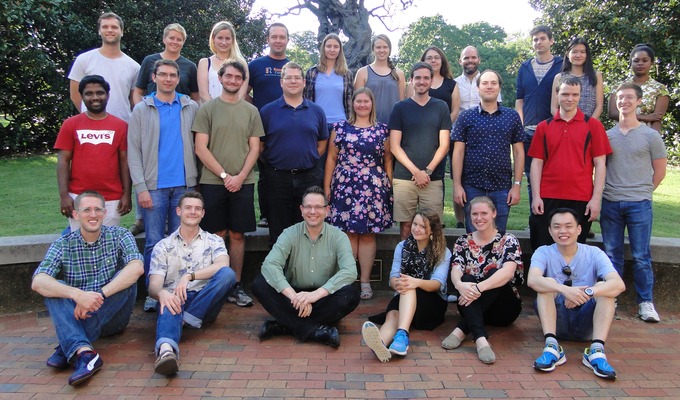 Meiler Lab 2018
The Bio Chemical Library (BCL) is a software package that provides unique tools for biological research, such as protein structure determination from sparse experimental data. The BCL contains the widely used secondary structure prediction program JUFO, a folding algorithm that assembles secondary structure elements, and loop construction tools that complete protein backbones. With this series of protocols the BCL allows construction of backbone models for large and membrane proteins from the more...
Despite improvements on both experimental techniques and computational prediction methods for small and medium sized proteins, structure elucidation and prediction for larger proteins remains a major challenge. We are developing a structure prediction algorithm that incorporates data of various experimental techniques but also to be used as a standalone tool. The algorithm utilizes a novel sampling technique and employs the flexible combination of empirical and experimental scores.The pro more...
A growing technique in protein structure determination is cryo-electron microscopy. Cryo-EM provides low resolution electron density maps ( ~8 Ångström) . As this data become more accurate and you can use this data not only to determine the overall structure of protein complexes, but also to determine secondary structure elements and their assembly in the tertiary structure of a protein. The successful field of ab initio protein structure prediction ca more...
Antibody structural repertoires are determined through diversity of gene segment usage and the introduction of somatic mutations. This structural diversity is responsible for the recognition of an unlimited number of antigens. Traditional techniques for determining structure cannot characterize the breath of structural diversity that these antibody-antigen interactions can adopt because of limited throughput. Using the knowledge-based structural biology program Rosetta, we can use the results from c more...
About 30% of the proteins in the human body are membrane proteins. They have a wide variety of functions within the cell and it is therefore not surprising that over half of all known drugs target them. However, less than 1% of the structures deposited in the ProteinDataBank belong to membrane proteins. The reason for this discrepancy is the difficulty to crystallize them. Also conventional liquid-state NMR techniques reach their limits for membrane proteins more...
A first step towards protein tertiary structure prediction is the identification of secondary structure elements from the sequence. In addition, the identification of trans-membrane spans is required for membrane proteins.
The aim of this project is to simultaneously predict secondary structure and trans-membrane spans with a single tool. The rationale for this approach is the hypothesis that both phenomena are interrelated: more...
Small molecule design consists of assembly, docking, and scoring. Since Rosetta already has a docking algorithm (RosettaLigand) and a scoring framework, all that is needed for small molecule design is an assembly algorithm. As an initial approach, we have chosen random assembly of fragments from an input library. The algorithm is represented in figure 1. Each cycle of design consists of extending the small molecule with random fragments chosen from a library, filtering small molecule designs based on energ more...
Learning systems have a long history in being applied to reduce the search space for protein structure prediction e.g. artificial neural networks (ANN) and hidden markov models (HMM) are used for protein secondary structure prediction and motif recognition. Recently, ANNs were successfully utilized to derive a consensus amino acid contact prediction for unknown folds from fold recognition techniques. These predictions drive de novo prediction of protein tertiary structure towards better r more...
Electron paramagnetic resonance (EPR) can provide structural information on proteins not easily studied by other biophysical techniques such as nuclear magnetic resonance and X-ray crystallography. Inter-residue distances of up to 60Å and residue specific solvent exposure can be measured. Such data can be critical to defining the topology of a protein. However, the amount of information obtained from an EPR dataset is limited by its sparseness and difficulty in r more...
Using cryo-electron microscopy (cryoEM) numerous sub-nanometer resolution density maps of large macromolecular assemblies have been recently reported. Although no atomic detail is generally resolved in these density maps, at 7 Å resolution α-helices are observed as density rods. The Primary goal of this project is the development of a computational protein structure prediction algorithm that incorporates the experimental cryoEM density map as restraints. The placemen more...
HIV protease inhibitors (PIs) have been an important and successful model for structure-assisted drug design. At least ten PIs have been approved by the FDA since 1995. However because of HIV-1’s high mutation rate, PI therapies often succumb to drug resistance mutations. Computational methods that predict how a putative inhibitor will interact with various strains of HIV-1 protease will speed the development of new inhibitors that avoid resistance mutation. HIV-1 protease mutants more...
Six of the ten most frequent protein topologies have symmetry on the fold level. We postulate that the evolutionary origin of these symmetric superfolds lies in naturally occurring homo-oligomeric protein complexes that undergo gene duplication and fusion. To test this hypothesis the Rosetta protein design package was used to computationally design a two-fold symmetric variant of imidazole glycerol phosphate synthase (HisF). The new protein, termed FLR, adopts the symmetric βα TIM-barrel superfo more...
About Meiler Lab
Research in our laboratory seeks to fuse computational and experimental efforts to investigate proteins, the fundamental molecules of biology, and their interactions with small molecule substrates, therapeutics, or probes. We develop computational methods with three major ambitions in mind.
A) To enable protein structure elucidation of membrane proteins the primary target of most therapeutics and large macromolecular complexes such as viruses;
B) Design proteins with novel structure and/or function to explore novel approaches to protein therapeutics and deepen our understanding of protein folding pathways.
C) Understand the relation between chemical structure and biological activity quantitatively in order to design more efficient and more specific drugs.
Crucial for our success is the experimental validation of our computational approaches which we pursue in our laboratory or in collaboration with other scientists.
Current research applications focus on new approaches to a) drug and probe development for neurodegenerative disorders and diseases including Schizophrenia, Alzheimer's, and Parkinson's, b) understanding the structural determinants of antidepressant binding to neurotransmitter transporters, c) cardiac arrhythmia as caused by the complex interplay of potassium channel regulation and drug interactions, d) multidrug resistance in cancer and bacterial cells related to multidrug transporter proteins, and e) structural basis of viral infections and antibody activity.
News
- News
- In the Media
- Recent Articles
Windsor, M., "Vanderbilt, Leipzig research collaboration sees strong results." Research News @ Vanderbilt
Salisbury, D. "Leipzig collaboration yields valuable relationships." Vanderbilt Chemistry 2013.
Bartoo, C. "Controversial info release aids VUMC bird flu research" VUMC Reporter September 6, 2013.
Oak Ridge Associated Universities. "ORAU, ORNL announce winners of high-performance computing grant competition." Oak Ridge Today, 2013.
Snyder, B. "School for Science and Math students shine in Intel competition." VUMC Reporter, Jan 2013.
Meiler, J. "Die Bedeutung des FChO auf deinem akademischen Weg" Faszination Chemie 2013, 66.
Salisburg, D. "The Leipzig Connection," Research News@Vanderbilt, Vanderbilt University, Dec 2012.
Russel, J. "Bigger IS Better", Arts and Science, Vanderbilt University, Spring 2012.
Fortenberry, C. "International Chemistry: Shared reactions from Leipzig to Nashville." Vanderbilt International 2011.
Salisbury, David. "Creation of the largest human-design protein boosts protein engineering efforts." Vanderbilt Reporter, Nov 2011.
Synder, B. "School for Science and Math student sees paper published." VUMC Reporter, Vol XXI, 34. Sep 2011.
Snyder, B. "Study shows how G proteins get "turned on" by receptors" Vanderbilt Reporter 2011.
Baynham, D. Q.; Karakas, M.; Meiler, J. "Protein Structure Prediction Using Rosetta" Young Scientist, May 2011, p11-12
Smith, S. "As Beckman Scholars, undergraduates experience responsibility and research life" Arts & Science, Vanderbilt University, Spring 2011
Schreiber, A.; Meiler, J. "Modellierung G-Protein-gekoppelter Rezeptoren mit ROSETTA " Biospektrum
Joetten, F. "Formvollendet" Bild der Wissenschaft 2010, 4, 18-23.
Omlor, A.; Meiler, J. "Zu Gast im Meiler Lab an der Vanderbilt University in Nashville Tennessee!"
Jaehnigen, S.; Grjasnow, A.; Meiler, J. "Chemische und strukturelle Biologie waehrend eines Praktikum in den USA" Faszination Chemie 2009, 14., p12-16
Marino, M. "Undergraduate Open House" Vanderbilt Reporter 2008, 4.
Lerner, M. "Europe's Brain Drain" European Hospital 2008, 17, 4.
Marino, M. "Program promotes greater diversity in molecular sciences" Vanderbilt Reporter 2007, 3.
Salisbury, D. F. "Campus 'supercomputer' helps decipher mysteries of science" Vanderbilt Register 2
Joetten, F. "Ich, der Roboter" Die Zeit 2007, 41, 42-43.
Meiler, J. "Kuenstliche Intelligenz in Chemie und Biologie" Faszination Chemie 2001, 7, 35-43.
Synthesis, Antiplasmodial, and Antileukemia Activity of Dihydroartemisinin-HDAC Inhubitor Hybrids as Multitarget Drugs (2022) Pharmaceuticals
Maik Tretbar;Reni Kitte*, Sarah Dluczeka, Lorenz Beckmann, Peter Marquardt, Anna Duenkel Andreas Schubert Stephan Fricke, U. Sandy Tretbar *equal first authorship
Chemical and Cytotoxic Activity of three main Sesquiterpenoids from Warburgia ugandensis (2021) Results in Chemistry
Xia Y;Ledwitch K, Kuenze G, Duran A, Li J, Sanders CR, Manning C, Meiler J
A unified structural model of the mammalian translocator protein (TSPO) (2019) J Biomol NMR
Vu O; Mendenhall, Altarawy, Meiler
BCL::Mol2D-a robust atom environment descriptor for QSAR modeling and lead optimization. (2019) J Comput Aided Mol Des.
Brown BP;Mendenhall J, Meiler J
BCL::MolAlign: Three-Dimensional Small Molecule Alignment for Pharmacophore Mapping. (2019) J Chem Inf Model
Roushar FJ;Gruenhagen TC, Penn WD, Li B, Meiler J, Jastrzebska, Schlebach
Contribution of Cotranslational Folding Defects to Membrane Protein Homeostasis. (2019) J Am Chem Soc
Butkiewicz M;Rodriguez AL, Rainey SE, Wieting J, Luscombe VB, Stauffer SR, Lindsley CW, Conn PJ, Meiler J
Identification of Novel Allosteric Modulators of Metabotropic Glutamate Receptor Subtype 5 Acting at Site Distinct from 2-Methyl-6-(phenylethynyl)-pyridine Binding. (2019) ACS Chem Neurosci.
Li B;Mendenhall J, Meiler J
Interfaces Between Alpha-helical Integral Membrane Proteins: Characterization, Prediction, and Docking. (2019) Comput Struct Biotechnol J.